Ad

Transparent cap covers

Meg

New member
Hi! This is my first post! So thanks in advance I’d anyone can help me.

I have an adapted Mongolian yurt in use full time in rainy Cumbria UK.

We often have to put our crown cap (the extra canvas that covers our Perspex sky light incase I’m using the wrong terminology!) in spring and late summer. This blocks a lot of light and I wondered if anyone new if you could buy a transparent additional crown cover. Ours is currently heavy canvas same as our overall outer walls.

Whenever I’ve looked they seem to be £400??? Which makes me think I’m typing in the wrong thing!


Many thanks

Meg
 
I'm no expert on yurt covers, but here is a suggestion. If you want a lot of light and full on rain protection that is very affordable and easy to make yourself, you might consider using greenhouse plastic.

I built us a small 10x15 greenhouse this year. The greenhouse plastic I bought is a 4 year rated material -note: not big box store variety- and is VERY tough and UV resistant, unlike the box store stuff which won't last a year. I know that from having covered tomatos with the stuff and it is JUNK plastic. I bought it from a greenhouse supply store. Pick one, the plastic is probably the same everywhere, as long as it is called 'greenhouse plastic'. It comes in any size.

To make a flat sheet cover your yurts ring, or as much of the roof as you desire, lay the sheeting atop the yurt. Make a single cut up to the apex. Slide the cut edges past eachother to form a cone that fits the roof. Tack the seams with tape. Remove and thoroughly tape the seam with packing tape or other clear heavy duty tape. There's likely 'greenhouse plastic tape' for all I know.

Good luck.
 
Last edited:
To make a flat sheet cover your yurts ring, or as much of the roof as you desire, lay the sheeting atop the yurt. Make a single cut up to the apex. Slide the cut edges past eachother to form a cone that fits the roof. Tack the seams with tape. Remove and thoroughly tape the seam with packing tape or other clear heavy duty tape. There's likely 'greenhouse plastic tape' for all I know.

And don´t forget to protect your sheet from the heat of the chimney.... ;)

Good luck.

Of course. That´s always necessary on such projects. :D
 
Good point Ralex. Nothing quite as nasty as fire melted plastic. Been there done that. Get a fireproof wall tent stovejack.

Another possibility is to just pull the roof cover back so light get in somewhere other than where the stovepipe is situated, and then work sheeting under the cover but over the wall cover.


Keep in mind it's just a simple yurt cover. Getting more light in there IS gonna happen. Experiment and you'll figure it out. Keep it simple. Good luck.
 
Thank you all for the help! I should have added that our stove goes out the side so won’t effect the crown at all!

Going to try this!

Thanks again!
 
We often have to put our crown cap (the extra canvas that covers our Perspex sky light incase I’m using the wrong terminology!) in spring and late summer. This blocks a lot of light and I wondered if anyone new if you could buy a transparent additional crown cover. Ours is currently heavy canvas same as our overall outer walls.

Welcome Meg.

I'm originally from the UK (eons ago) and now live in Mongolia.

I agree with the idea of a sheet of strong plastic. In Mongolia we use these in winter to cut the cold down. Your situation might be due to rain?

In our situation cold is the main enemy. I imagine it gets cold in Cumbrian winter. So, in addition to what others have suggested - good suggestions for rain, I'd consider the plastic on the inside. The plastic could be stuck to anything and tightened with nano tape. Some types of plastic can be heat shrunk to make it nice and tight for maximum visibility.

The downside is you may not be able to operate the opening/closing of the crown. However, we could still open ours from the outside but it's probably very rarely necessary.

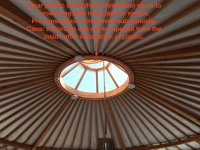
A photo of your crown would really help. I'll show you mine with some notes. It's a modern yurt, not traditional.

IMG_0765.jpg

Like I said, this is more of a winter cold solution which may or may not work for you. I've done this on windows in Mongolia in houses/flats and it increases the insulation of windows considerably without affecting visibility much. I haven't done it to our yurts yet BUT winter is coming, so I might do it this year.
 
If you´re using an electric opener the problem is solved, isn´t it?

Yes, I haven't seen those. Are they common?

However, I can't think why you'd want to open the crown when it's sealed inside with plastic. We could open hours from the outside too but it's awkward. We'd probably just keep it closed the 9 months of winter where I live. It snowed a bit today.
 
Yes, I haven't seen those. Are they common?

I believe, that Pacific Yurt is offering electric dome openers.

However, I can't think why you'd want to open the crown when it's sealed inside with plastic.

Of course, but I imagine I would not use a sealed plastic. ;)
Instead I would prefer an acrylic plate which can be removed in warm times and the plate should have as well an possibility to open it on demand.

So I can open both - the dome AND the plate - to get fully fresh air ventilation for some times during the day.... :)
 
All good suggestions. However, It sounds like the original poster was looking for a low cost solution. I imagine heat shrink clear window film might be the cheapest possible solution.
 
....It sounds like the original poster was looking for a low cost solution. ....

But sometimes a seemingly cost-effective solution turns out to be an expensive one.

And in this case - if one of the biggest problems in Yurt living, the mold growth, due to too little fresh air circulation is arising - it could become considerably more cost-intensive for its elimination. than if you create a workable solution right from the start.

From the unpleasant situation of having to fight with mold, I do not want to start now.....
 
But sometimes a seemingly cost-effective solution turns out to be an expensive one.

And in this case - if one of the biggest problems in Yurt living, the mold growth, due to too little fresh air circulation is arising - it could become considerably more cost-intensive for its elimination. than if you create a workable solution right from the start.

From the unpleasant situation of having to fight with mold, I do not want to start now.....

Fair point. Mold is not an issue in Mongolia. But I concede it would be in the UK (and other places around the world). Cumbria, UK, is a very rainy region.
 
You can have mold issues even in dry areas if your yurt doesn't breathe properly unfortunately. We have seen this many times here in the forum over the years when people get overzealous with insulating their yurts or when they create a lot of moisture inside the yurt (propane, bathing, cooking, etc..).

In my opinion, mold is the #1 thing you need to be looking for in a yurt. If you ventilate properly, you will be fine, but if you lock it up tight, it won't matter if you are in the desert somewhere, it will begin to grow.
 
You can have mold issues even in dry areas if your yurt doesn't breathe properly unfortunately.
.......
In my opinion, mold is the #1 thing you need to be looking for in a yurt. If you ventilate properly, you will be fine, but if you lock it up tight, it won't matter if you are in the desert somewhere, it will begin to grow.

This POV is shared by an Kazakh Yurt producer I spoke in the past.

And it´s the reason, why he is using mostly synthetic insulation instead sheep wool. It has reduced the number of sad customers....
 
W. Hodding Carter wore forty pounds of sopping wet wool, and stayed quite warm crossing the north Atlantic from Greenland to Canada, in a recreated 55' Viking longboat. He details the wool clothing he wore during the adventure in his book, "A Viking Voyage'. I highly recommend that read.
 
Last edited:
W. Hodding Carter wore forty pounds of sopping wet wool, and stayed quite warm crossing the north Atlantic from Greenland to Canada, in a recreated 55' Viking longboat.

Also wool clothing is still a big player in todays synthetic clothing outdoor wear.

Of course, Bob, but it´s a big difference to wear wool clothing, which are permanently again & again in contact with fresh air - they can get wet and don´t loose their characteristics (see sheep on the meadow - they never mold :p ), or to have wool as wall insulation - always on the same place - which has not ventilation..... ;)
 
Last edited:
Back
Top