Ad

Stove pipe horizontal qn

jona

New member
Soon mn yurt will be set up.

I need some info about mn multi burner.

Qn 1 the horizontal double-walled pipe that goes from the stove through the yurt wall, how do I clean it from the shaft?

Qn 2 the chimney must necessarily be vertical or can it also be horizontal and then not a vertical pipe Does that possibly have to do with the flow of the stove or lack of flow of the gases?
 
Install a 'clean out' stovepipe fitting where the horizontal and vertical pipe meet on the outside of the yurt. That allows cleaning the horizontal run.

As for horizontal only, man I would NOT do that. Chimneys and stove pipes always exit vertically, after an ell or two. Hot gas needs to move vertically for a good draw. Even installs in camping hot tents have the pipe running up on about a 45 degree angle from the bendable pipe fitting.

Burn dry wood. Plus give your stove a good shot of air each firing with dampers wide open. That helps minimize the buildup of creosote in the pipe. I've 'never' swept our stovepipe in 22 years, because I burn dry wood, and with the flue wide open and a very hot fire at the start of the burn. But that's just me. Burn safe.

Good luck.
 
Last edited:
Another point. Not yurts, but...in new home construction, by code the top of a fireplace/woodstove chimney stack that's within 10 lineal feet of a ridgeline, needs to extend ABOVE that ridge by 2'.

Beats me if that applies to yurts or not, since they have a conic roof and no ridge. Just thought I'd mention it though.

Also, the stack on my yurt extended above the ring by a couple feet. Even at that height, and with a spark arrestor -not a rain cap- I still got ember burns in the cotton canvas.

I 'WOULD NOT' do a horizontal pipe. I'm thinking that wind could blow embers directly at the yurt. Just sayin'. Good luck.
 
Also, worse yet, I'm thinking under certain circumstances a horizontal pipe could allow lots of embers to get blown into the yurt when the door is opened. Muy malo.
 
Funny, i just called with a seller for stove pipe goodies and explained an issue and the situation when he explained to me that a horizontal excit was much better than a vertical. When i explained i was in a yurt he knew appearently some customers and was quite firm about this. I explained what i learned from this topic and the answer was that the draft in the chimney was much better as he took a vacuum cleaner as a example. I give value to his reply, but yours are field experts so that leading for me. I just wanted to post.

Also is 2x 45degree better dan 1x90 regarding draft.
 
Straight up.

Think about this. Steam train, paddlewheeler steam boat, oil burning battleship engines, Titanic liner, industrial plant pipes, all exhausts go as straight up as possible. They don't make horizontal runs 'because they draft better horizontally'. lol If they do have a horizontal run it is entirely because other issues with the design preclude a straight vertical exhaust.

That said a yurt wood stove can draft fine with a horizontal run out the side wall and an 90 degree ell. They go sideways due to stack exiting roof and leaking, vs side wall and less likelyhood of a leak. Issue with water leakage at the roof jack in a cloth roof that isn't flashed like on a gabled house roof, not because the horizontal run is 'a superior draft'. Also the less 90 degree bends the better for flow. So yes two 45 degree bends is better flow than one 90. It's all about air friction, and the fact hot air naturally rises it doesn't travel sideways.


Old school carbureted straight 6 engine like my 300 Ford with 90 turn in intake manifold to head and sharp, rough surfaces inside the manifold is the absolute worst for air flow into the engine. Curved intake manifold with as full a curved sweep as possible is absolutely 'THE' best design for multi cylinder carb engine intake. All high performance intake manifolds are curved. End of story. In addition related to friction and flow, 'port and polish' is standard to increase moving air moving through a high performance internal combustion engine, which is basically an air pump. Old school carbed motorcycles the carb is STRAIGHT shot into the cylinder, dang near bolted to it. Small engines like mowers tillers weedwhackers chainsaws etc. do have the carb bolted to the engine. The flow speeds up in the carb, not before.

So straight up is best when possible on a single exhaust. Airplane engines exhaust immediately outside the cowling, they aren't piped to the rear of the fuselage. Exception is exhaust manifold piping on say a high performance V8 with many pipes being smooth curves of various lengths to get the correct back pressure. I'm no engineer but this is very basic stuff.

This took me freeking forever to type, correct typos, edit etc. So....I'M OUTTA HERE on a bicycle ride. Later gator! haha
 
Last edited:
One last point. Back in the 1980s there was a brick masonry fireplace design in 'Fine Homebuilding' magazine that featured the exhaust flue changing direction many times in a mass of bricks. The intent being to heat the mass by longer runs of exhaust, then radiate the stored heat in the dwelling.

All that wood smoke would cool inside the runs, creosote form, and >zero< way to clean it out. Plus how the heck they got that sucker to draw to begin with beats the heck out of me. Singularly 'THE' lousiest wood burning flue design of all time imo. I'm on board with standard masonry fireplaces, and especially when they exhaust straight up. Rumford in particular is a fantastic open fireplace design.

OK, class is dismissed. lol
 
Last edited:
Ok the car type explanation made the - aha - moment.
Like so many things there's allways more options each with its own +/- that have been well explained.
Thanks both of you for the well spoken words and sharing of your valuable info.
It's appreciated.
Thanks for spending your time and knowledge for me.
 
You will want the horizontal option simply because the roof will eventually leak if you go through it. There are options to go through the center ring but then you lose the ability to open and close it.
 
Yep. No flashing. BUT I've never seen one up close so there's that. I'm just thinking exiting vertically through cloth, its GONNA leak at some point.
 
I see no problem at all with a short stack run horizontally out the side wall and then into an ell designed for clean out. On 'standardized' larger American yurts I'm thinking that might even be the normal install for code reasons and safety. I really doubt there is any draft type problem with one ell.

Aside from 'no leak' an additional benefit with side wall exit vs vertical is cutting the percentage of embers that land on the roof. Not all necessarily, but I'm betting a whole lot less then with the central stack I used for six years.

I made a spark arrestor from 1/4" mesh. That cut the volume down substantially, but it didn't halt some from landing on the canvas. If my yurt was my primary home and a big investment that would certainly would have been a BIG issue. Flame retardant canvas-I didn't use that. But I WOULD have if I had a wife and children living in the yurt.
 
I can attest to the fact that roof penetrations for chimney flues will leak. I suppose you could prevent it with annual maintenance. We just accept that leaks will happen. We have one of those rubberized chimney flashings but it's not perfect.

This is the outside before the decorative canvas went up.
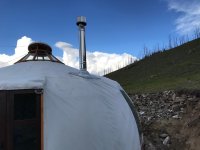
Chimney without finished canvas.jpeg

Then another (we have 2 of these gers) with final, decorative canvas installed.
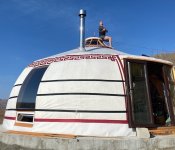
Chimney with final canvas.jpeg

The leaks occur on the top lip. Either copious amounts of sealant which tends to last only 1 year of our extreme weather, or an extra fly sheet would prevent this entirely.

So, I can think of experiments I could do with a mini-fly sheet just for the segment of roof with the chimney but the chimney pipe still has to go through somewhere. It'd have to be heat resistant. I've had my fair share of burnt canvases touching single wall chimneys. That being said, our chimney is double-walled and insulated so probably wouldn't burn/melt.

We didn't really see the advantage of a side venting stove because our walls are curved in the vertical axis too. So there'd still be leak risk there too.

Traditional Mongolian gers do leak. However, it's not a rainy climate. So they get wet and then they dry in cycles of wet and sunny weather for just the short summer. They aren't waterproof. They are designed to breathe. We just accept some leakage and deal with it. Most traditional gers just have roll vinyl floors and are easy to mop. If some rain gets in.

If you're in a temperate climate, like the UK, or the USA's PNW where it rains all year round, I think a side vent might be a better approach.

 
Here's an idea on REALLY sealing that stove pipe. Make a flashing sandwich with the middle layer being the cover. Inside and outside are sheet flashing with the cover trapped between the two. Silicone the crap out of the two sheet flashings and then screw the two layers together. Just an idea. Beats me how it would work in the real world.
 
I think Bob is on to something there. I was thinking of something similar too..
 
Back
Top