Ad

New, modern yurt build in Mongolia

UKadventurer

New member
This is my first post so I'll introduce myself too.

I'm a British expat, now in early retirement, who has lived in the UK, USA and finally Asia since roughly 2007. I'm in a 7 year relationship with a Mongolian woman and after years of wandering and not being settled, we decided to settle down with a home base. In Mongolia. My budget was limited so 'gers' (Mongolian word for yurts) looked like a good prospect. Land is plentiful and cheap for Mongolians in the mountains surrounding Ulaanbaatar.

After searching for a few months and a few false starts, we found 7 connected lots totalling about 2 acres of virgin land and the cost was about US$11k. However, that's a bit misleading because our land opens to a huge amount of common land. Millions of acres. We're at the top of a side valley and own the highest buildable land. The views are fantastic. Below is buildable but nobody has built within 600 meters of us yet.


We chose 2 modern gers rather than traditional ones. Although we also have a traditional one for cooking and guests at the moment. A local company (Tsomtsog gers) builds fancy, modern gers for tourist camps. So we were able to try before we ordered ours. We spent a night in one 6m ger and had a visit to some 7m gers. We ordered 2 of the 7m (internal dia) variants with extra windows and a connecting hallway so we could use one for sleeping and one for living. We will probably live in them 4-seasons so we wanted something very cozy. The cost was about US$7k for each ger and around US$3k for the connecting hallway. Although we might build the connecting hallway/bathroom ourselves. This didn't include foundations and we were quoted US$5k for the foundations. We decided to do the foundations ourselves.

First step, the slope is about 10 degrees so I looked at building a post and beam platform but it was too pricey due to the cost of lumber and steel. Excavation is cheaper so we paid for a company to cut and fill a large platform for 2 gers (7.2m external diameter), 2 x 20 ton shipping containers, and a flat area for outdoor living.

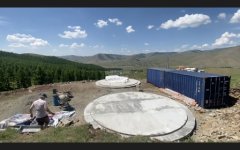
Initially, we erected a traditional Mongolian ger where we could live while the construction was going on. We built a simple platform with rocks and gravel plus wood floor for this one. For the fancy gers, I designed a more permanent and durable foundation: concrete block ring with inner supporting blocks. It would be filled with expanded clay insulation and then have a concrete ring (30cm/12" tall) and raised pad (10cm/4" thick). We used wire grid reinforcement in the concrete.

The concrete foundation was a family affair and I think I saved about US$1k by doing a DIY method. Not a lot in hindsight but a bonding experience.

Next the ger company showed up with just two workers instead of the usual 4-5 so some of my wife's family members were hired to help. The build took 5 days to make the 2 gers livable but they are still missing the cosmetic outer cover and a couple of side doors. We should get them delivered and installed this week or next.

I had recently had back surgery, so I was sidelined to management. However, I've been doing all the electrical work myself. We have a grid connection that we had to pay quite a lot for due to the distance from a transformer. About $8k but after that the kW rates are very low here. We're getting a well drilled this week for about $5k. We're probably going to have a gray-water / composting system soon too.

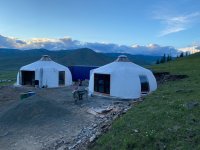
We've still got loads to do but at least we moved in. We have 3 yurts, one traditional one for cooking and guest, 2 fancy ones for us and guests, and 2 shipping containers for secure storage/garage/workshop use.

Some photos for you:

A concrete foundation. We'll need to add another section for the hallway / bathroom.
06 foundations.jpg

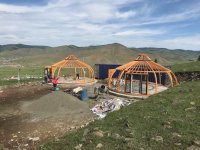
This is the frame work, without lattice wall yet.
07 build frame.jpeg

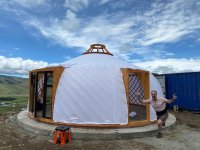
An inner liner is added over the structure.
08 inner material.jpeg

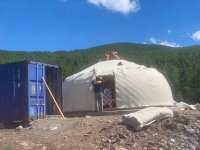
Insulation is locally sourced wool felts in 2 layers.
09 wool felt.jpeg

Next is a waterproof canvas.
10 waterproof layer.jpeg

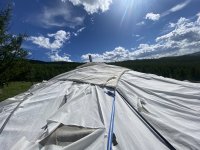
Not installed yet, the cosmetic outer cover and tensioning straps. Also, 2 side doors.
 
Last edited:
I think there's a limit on attached images, I'll add more here.

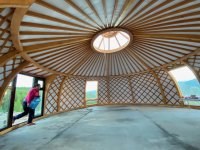
This is how one of the gers looks inside. We specified 2 windows but we like them so much we'll probably get a 3rd. There's also a 3 panel aluminum and glass door. We'll also have a side door of aluminum and glass.

Eventually, we'll add underfloor electric heating and install a wood-burning stove. Winters are harsh in the Mongolian mountains. The coldest nightime temps can reach -40C/F.

ger interior.jpeg

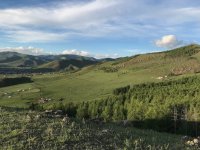
A view of the compound from a nearby hill. The compound is on the right of the frame.
99b go hiking.jpeg

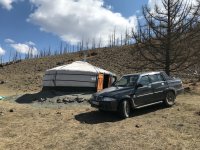
This is our traditional ger that we use for cooking and guests.
03a build standard ger.jpeg

A picture of us.
happy couple.jpeg

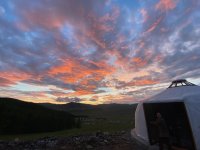
A sunset without people.
sunset.jpeg
 
Thank you very much for sharing your experiences and the great impressions.

I visited Mongolia in 2000 and droved more than 1000 kilometers on (Chinese) bicycle and had an 6-day (daily 8-10 hours) ride on horseback....

Incredible time....

1566393-3-o_orig.jpg


024-nr_orig.jpg
 
Very cool, dude. I regularly ride my 1989 TREK 8500 around Co Spgs. the official Olympic City USA. Jennifer Valente, the 2020 Olympic gold medalist in track cycling, lives directly across the street from my son. She's blown by me a few times on my rides. That chick is RIPPED. I'll bet she regularly rides 300-400 miles a week.
 
Last edited:
Those are some bad ass yurts. Please update this thread when you're finished and have them all furnished. Outstanding!
 
Now I´ve had the time to view your pics more in detail and the most interesting thing I´ve seen is the crown (center ring) in your modern Yurts.

For easier understanding I´m copying your pics again:

attachment.php


attachment.php


What are the reasons for such a design? Dome Light alone, or are some other advantages more with this construction?

As example on opposite your traditional Yurt with an outside view - the difference is clearly to see...

attachment.php
 
Hi, good question. I know traditional Mongolian gers quite well. The 'tohn' (crown) has multiple functions. Ventilation, light, and time keeping. The modern ger has most of those elements but does it a little differently.

Time keeping: Think of the crown as a clock but with 8 divisions. You can learn to tell the time approximately as long as there's some sun. Mongolia is a sunny country. It's a sun dial essentially.

Light: Obviously it brings a lot of light in which is essential with traditional gers which have no windows and a tiny door. Not so much a modern ger which has one or more windows.

Ventilation: In the modern version, the centre of the crown opens enough to ventilate but will still keep the rain out unless it's driving rain from the south, in our ger. In a traditional one there's a 'tohn' cover which is a square piece of canvas and insulation that must be pulled over the opening with long straps when the weather requires it. You need to do this from outside which isn't great in a storm or blizzard - plan ahead. The crown frame might have no glass at all, sometimes plastic sheet, and one opening has a metal sheet to hold the chimney. We can open and close ours from indoors. We'll have wood stoves but near the wall, not in the traditional centre of the ger.

We have outside covers for the crown - canvas only - which we haven't used yet but might have to use in the winter. The glass in the crown is just single pane and there's essentially no insulation in that area. It'd be a shame to cover the crown because I love the feel of being able to see the sky, especially at night. However, when the temps hit -40C we might be covering all of the windows (most are double glazed, the crown is single glazed).

However, electricity is cheap and fallen wood free so we'll have to see how it goes. This winter will be our first in gers full time.

Next week, we'll have underfloor electric heating installed. It's already getting cold at night.
 
Hi, good question.....

Thanks for your detailed explanations and for sharing your thoughts. :cool:

During my time in Mongolia we had some rainy days, but at those we had no Yurt overnights.

I wonder how the Nomads are handling the heating during heavy rain - how do they cover the big hole on the roof with the hot chimney? Any ideas?
 
Thanks for your detailed explanations and for sharing your thoughts. :cool:

During my time in Mongolia we had some rainy days, but at those we had no Yurt overnights.

I wonder how the Nomads are handling the heating during heavy rain - how do they cover the big hole on the roof with the hot chimney? Any ideas?

Glad to answer. We've had a very wet summer. There is definitely a certain amount of leakage in traditional gers, especially around the chimney. The crown cover can not touch the chimney because, as I found out, it will burn the fabric or melt it. Depending on the type of material. Chimneys here a single wall metal, so they are extremely hot even in the opening.

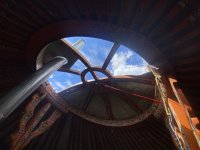
So the crown cover must wrap around the chimney without touching it, yet still cover as much of the crown openings as possible. I took a photo of the traditional ger on our land. It's in poor shape but it's owned by my wife's cousin. So it's up to him to fix it. You can see the crown cover in the outside shot.

The inside photo shows that the chimney is not a tight fit with the sheet metal holding it. Leakage is typical here but nobody cares. I was in a hail storm with 1-2cm hail stones, quite a few came inside and bounced around the ger. Fun!

Traditional gers have quite a few flaws but nobody seems to mind. Storms come and go. The sun follows rain and everything dries out. Personally, I prefer the modern design and want to make it as efficient as a house.
 

Attachments

  • tohn cover.JPG
    tohn cover.JPG
    2.6 MB · Views: 7,277
  • looking out the tohn.JPG
    looking out the tohn.JPG
    3.1 MB · Views: 7,238
Thanks again for your qualified answer, @UKadventurer. :cool:

There is definitely a certain amount of leakage in traditional gers, especially around the chimney. The crown cover can not touch the chimney because, as I found out, it will burn the fabric or melt it. Depending on the type of material. Chimneys here a single wall metal, so they are extremely hot even in the opening.

They don´t use other chimneys on different reasons:

At first are the possibilities to buy insulated, high quality chimneys limited and second brings the radiation of an single wall metal chimneys additional heating..... ;)

Thanks too for the excellent and for understanding helpful pics....

Personally, I prefer the modern design and want to make it as efficient as a house.

Me too. :D
 
Well, the nomad design of ger/yurt is designed to transported, erected and dismantled in a few hours. Several times per year. The transportation part requires the lowest possible bulk and weight. Low cost too is a factor. I think a traditional ger costs about $1000-2000 new, depending on size, at the Narantuul market in Ulaanbaatar. I've seen some the smaller ones carried in and on a family car. These are the smallest ones with just one felt layer. The traditional one on our land took 2 cars because it's a 5-wall (6.2m diameter) with 2 felt layers.

Therefore, a minimalist stove and chimney fits the pragmatic style of nomads. Family's here love traditions so most of them who aren't nomads anymore still have a family ger on some land. This is their summer home for the holidays only, not a full-time home.

Our stove is a bit fancier. We did buy some double walled, insulated chimney parts, because it sort of made sense. After you've burned yourself (or your canvas) on the chimney, it makes more sense. Those parts are costly for a summer camp ger but for us it's intended as our only home, four seasons.

I'm looking forward to winter, as it will test us to the extreme. I hope we don't chicken out and fly to Vietnam for the winter - our little escape plan. That being said we have multiple backup heat sources (electric, wood, propane and diesel (generator AND heater)).

Since I took early retirement this is a lot of fun for me. The projects could keep me busy for the rest of my life. Or at least until I'm incapable of physical work.

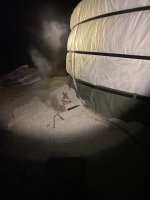
Besides the underfloor electric heating, I've added some photos of the other methods. Each has its disadvantages and advantages. The diesel has to be exhausted carefully but the fumes can re-enter the ger if the wind is not favourable. My wife complained of the smell immediately.
diesel heater exhaust.jpeg

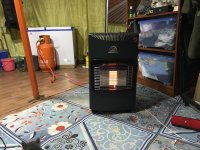
Propane needs lots of fresh air which sort of defeats the object when it's extremely cold outside.
propane heater.jpeg


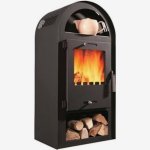
Wood burning requires a lot of attention to keep it fed. We bought two of these, one for each modern ger.
wood burning stove.jpeg

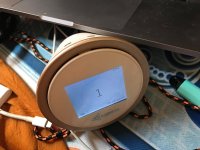
The air quality is normally incredibly good so we'd rather not mess it up. I've got an air quality monitor which shows the lowest setting most days.

IMG_0419.jpeg
 
Again great stuff and excellent detailed explanation. :cool:

Since I took early retirement this is a lot of fun for me. The projects could keep me busy for the rest of my life. Or at least until I'm incapable of physical work.

You don´t need to do the physical work by yourself till an breakdown - try to become early an good commander and delegate the hard work. ;)

As long you feel fit you can always give a hand - but the people around should see such action as honor, that you´re working together with them, it should not be the daily standard.... :D
 
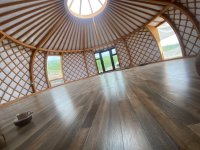
We added underfloor heating and laminate floor. Total cost was about $1700 installed for 2 x 7m diameter gers. We paid professionals to do it. I’m not comfortable making this my first such project. I’ve installed hardwood floors in rectangular houses but never a circular one. Just to refresh your memory, our foundation is concrete with expanded clay insulation.

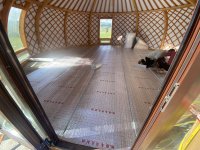
Step 1 was unrolling 8mm thick Mylar backed foam. This reflects heat upwards and accommodates small surface variations in the concrete.
84158190-B113-4FF7-AB23-CF19F9DD80A8.jpeg

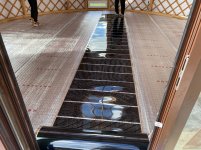
Step 2 is unrolling and connecting the underfloor mats. They are from a Korean company. They don’t cover the entire floor because you can’t cut them crosswise. Of the 40m/2 of each floor, about 27m/2 is heated. In 2 zones for some reason. We have 240v so each zone has a 16 amp circuit breaker.
B29C7760-2D16-48C6-BA7B-01BD219748B6.jpg

Finally, the laminate floor is installed. There’s tons of accurate cuts required. Not shown is the very final step of using the same wood used for the lattice walls as a trim edge to hide the gaps. Between floor and bottom ring. We chose a contrasting tone of floor in the widest planks available for fewer seams and cuts. The plank dimensions are 1.2m x 0.8m x 1.2cm thick.

6FE2CC41-590D-4BAD-B737-6645A5C8FB72.jpeg
 
What was the reason for the laminate floor, and not laying an parquet flooring (like bamboo e.g.)?

BTW - it looks cool and really professional.... :cool:

Thanks, we like it a lot.

Choices in Mongolia are very, very limited. You can import flooring - usually from China - but it's slow and costly. So I went with what was available locally and in stock in the largest plank size. There were only 3 choices of pattern. That's what I mean by limited.

Laminate planks are cheap, quick to install and look good enough.

When I lived in the USA, I had bamboo and African hardwood floors which I installed myself. They look great but aren't available in stock here. Also, if I remember correctly, they were much more costly. My budget is much lower now. If money and time was not a factor, I would've chosen bamboo floors.
 
If money and time was not a factor, I would've chosen bamboo floors.

Me too. :cool:

Choices in Mongolia are very, very limited. You can import flooring - usually from China - but it's slow and costly.

Slow & costly? I have an German friend and he is located in Novosibirsk, which is approx. 1000 km far away from the North-Western-Border of Mongolia - plus additional 1600 km from Ulaanbaatar, and he bought bamboo floor from China, with an excellent price (as half of the costs in EU) and it was delivered within 2 weeks....
 
Me too. :cool:

Slow & costly? I have an German friend and he is located in Novosibirsk, which is approx. 1000 km far away from the North-Western-Border of Mongolia - plus additional 1600 km from Ulaanbaatar, and he bought bamboo floor from China, with an excellent price (as half of the costs in EU) and it was delivered within 2 weeks....

When was that? Unfortunately Inner Mongolia has been closed several times due to China's zero Covid policy. This stops all ground freight and goods to Mongolia. It happened last year and it's happened again recently. I ordered an electric mountain bike from China. It was stuck in a warehouse at the border for 3 months. Only air freight is coming in and slower than usual due to less flights. Even air freight items such as my 4g booster antenna took 3 weeks. Mostly waiting for a flight from Incheon, Korea to Ulaanbaatar.

I'm not sure about the cost of bamboo. A quick search at alibaba.com shows about US$18 per square meter (plus shipping). My laminate floor was US$9 delivered. You usually have to buy large quantities with alibaba. Also, we were in a hurry and winter is coming. Nights are already getting cold and we needed the underfloor heating up and running quickly. So there was that factor too. We can now heat our gers and we are already using it!

Next step, of many, is to install the wood stoves we've had stored in our shipping containers for a few weeks. I love a wood burning fire and the wood is free.
 
When was that? Unfortunately Inner Mongolia has been closed several times due to China's zero Covid policy. This stops all ground freight and goods to Mongolia.
.....
My laminate floor was US$9 delivered.
....
Alibaba
.....

He bought FCL (40") - for US$11/m² - which was pretty much stuff for him, but he sold the unneeded floor for an reasonable, but although profitable price.
Delivery was last march by truck.

He bought not via Alibaba - he has had an direct supplier as far as I know...
 
He bought FCL (40") - for US$11/m² - which was pretty much stuff for him, but he sold the unneeded floor for an reasonable, but although profitable price.
Delivery was last march by truck.

He bought not via Alibaba - he has had an direct supplier as far as I know...

It’s a decent price but shipping is impossible at the moment.
 
Back
Top