Ad

How to properly heat my yurt?

Kylestyle88

New member
Hi there, I'm new to this community and excited to be a part ! I bought a yurt last year and it's been an amazing experience! Only problem is I'm having trouble heating it in the winter.

Last winter (which was my first winter) it got so cold a pipe burst and the yurt flooded. I live out of state (I operate it as an Airbnb) so I wasn't there to manage the temperature control. The yurt is raised up off the ground pretty high and the Neighbor told me I could skirt it to keep the temperatures underneath the structure warmer, thus keeping pipes from freezing and encouraging warmer air to radiate up through the floorboards. Is this a possible fix? If so how would I do this?

I'm also planning to install a pellet stove double the size of my current one, and possibly insulate the walls inside the bathroom space where most of the pipes are located. Pls let me know if anyone has any additional recommendations. I love my charming little yurt so much but it's draining by me financially and I need to get this figured out - thanks in advance!
 
If the temp drops below freezing all exposed water piping WILL freeze. If you aren't around drain the water system.

I installed insulated trailer skirt systems in Jackson WY back in 1980. In addition to the skirting we built insulated framed box enclosing the piping under the trailer and added heat tape. Even then there were freeze ups in the -30F temps if the occupants left and the e tape lost power. If the breaker tripped you were sol.

Off topic comment. Without any doubt working under an old school 60's 70's trailer in that funk and filth, in the cold, was one of 'THE' nastiest jobs I ever did, and I've done my share.

Good luck.
 
I'm not sure if my solution will help but I'll share anyway. Last winter we heated with underfloor electric heating. While, it did keep us warm down to -46C (-51F), which was the lowest night last winter, it cost us a fortune in electric bills. Our highest monthly bill was $460 for electricity, whereas it's $30 in Summer. So we looked for a cheaper solution for this coming winter.

We came up with a central heating system based on semi-coke briquette boiler feeding radiators in each 'ger' (Mongolian word for yurt) plus the bathroom, insulated shipping container and well house. 5 radiators total. We'll fit TRV (thermostatic radiator valves) soon. The whole 'open' system is filled with anti-freeze so it can't freeze until about -40C/F. Open systems allow simple expansion of the anti-freeze too.

We chose semi-coke briquettes as our fuel source because this is the only coal product that is legal in Mongolia now. They are also subsidized and rationed. We are allowed 7 bags a week (a bag is 25kg / 55lb) and it's sufficient. The advantage over wood is that it's much cheaper and will burn 12-16 hours without attention which is what we need in a Mongolian winter. Did I mention it's cheap? Yes, it's $1 per bag or about $40 per metric ton (2200 lbs). Our heating season is mid-September to mid-May.

Here are some pics.

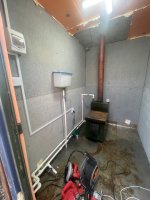
Furnace room in a shipping container in the back of the 2 (Siamese) gers, connected with a bathroom.
IMG_0884.jpeg

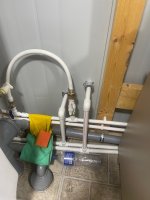
Pipes go underground (about 2m) then enter the bathroom, steel insulated panel construction.
IMG_0880.jpeg


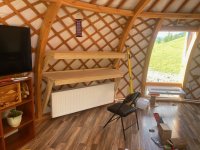
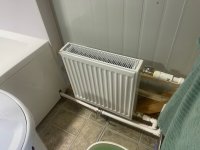
The living room 'ger' radiator. The bedroom is the same size. Our gers are 40m/2 (about 430sq ft). The bathroom and well house radiators are half this size.
IMG_0843.jpeg

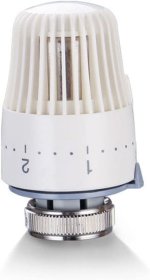
Thermostatic radiator valves control the temperature of each radiator. Some of them are just needed for "frostproofing", like our shipping container and well house.
Thermostatic radiator valves.jpg

We made an insulated, partitioned furnace room in one of our shipping containers. The pipes are insulated and go underground between the shipping container and the bathroom, then to each 'ger'. Another branch goes to the well house (about 30m away).

It was a bit of pain in the wallet to pay for a 2nd system when we'd already paid for underfloor heating but we should break even on the new system in the 2nd winter on electricity savings alone. It's Mongolia so it wasn't expensive by Western standards. About $3k installed. It's hard to put a price on staying warm in winter, especially when you would die without it.

I'm not sure how this would apply to the OP's situation. Maybe just anti-freeze would work? Or underfloor electric heating. Insulation is very important but I can't say our 'gers' our very insulated by house standards with just 5-7cm (2-3") of wool felt. A lot of people with a single ger and no extra buildings just use a stove. A dual-use wood/coal stove is very nice but might not suit airb'n'b if you're not onsite.
 

Attachments

  • IMG_0879.jpeg
    IMG_0879.jpeg
    229.9 KB · Views: 349
Last edited:
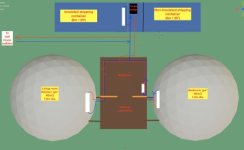
A schematic, more or less to scale, might help.

Heating and radiator schematic.jpg

The well house isn't shown - it's about 30m to the south from the furnace. Those pipes are insulated and underground.

The radiators (thick white lines in the schematic) aren't exactly in their final location but other than that, the schematic is pretty accurate.

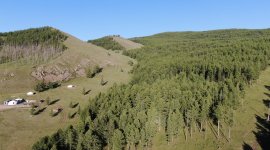
From a drone, our camp looks like this in Summer. We have 4 gers now. Two modern ones and two traditional ones:

Our camp still shot copy.jpeg

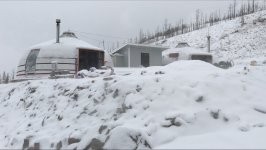
Last winter, it looked like this:

winter view of our living gers during a blizzard.jpg

The traditional gers are just heated with a standalone wood stove but we're going to convert them to coke burning with some firebricks, airflow controls etc. They look like this:

wood stove basic.jpeg

Or a modern wood stove, looks like this:

wood stove modern.jpeg

In our modern gers, we now have coke fired radiators, underfloor electric, a wood stove in each. Then other emergency backups are electric space heaters, propane space heater and diesel space heater. If all else fails, we have lots and lots of down clothing and wool blankets.

We've started to have paying guests, so we're looking to extend our seaons by converting the basic, wood burning stoves, to semi-coke burning for an all night burn instead of wood which needs feeding every hour or two (at best).
 
Back
Top