Ad

Cooling a Yurt in the Midwest

I have been working on getting my yurt up for over a year. The yurt was actually gifted to me so I didn't start learning about yurts until I ran up against challenges. I finally got the electric in and on the first hot day, I turned on the AC, it's a portable air conditioner that vents out the wall. Granted it was 90 when I turned it on, but it never cooled down until the sun went down. I know it is better to keep the ac on instead of waiting until it's hot, but the clear dome is like trying to cool off the oven while pouring more heat in it. Anyone have any suggestions on the best way to tint the dome? The dome is acrylic on a 20' yurt. The AC is rated for 400 square foot and the yurt is a 318.

Any advice would be appreciated.
 
Look for places where you can get air infiltration, especially where the yurt wall meets your platform. I'd also feel the canvas layers on the inside and outside to get an idea of how much thermal radiation it's absorbing. AC works best when the building/room is sealed, and I know my yurt is not well sealed...

Other than that, I'd suggest what the traditional yurt approach is: get a square flap (say, 5 ft x 5 ft white canvas or shade cloth), tie ropes to the four corners, and use that to cover the dome, tying the ropes to a stake in the ground or an anchor point on your platform. The flap is called an 'urgh' technically. Depending on how you set things up, you can have it completely cover the dome, partially, or just a little.

I think there's been a few people that tack up some shade cloth on the bottom of the crown ring on the inside. If your dome opens, the shade cloth might work with the dome cracked a little. Or the reflective bubblewrap would really help, but it would block the light.

Lots of options. Get creative, see what works. Best of luck!
 
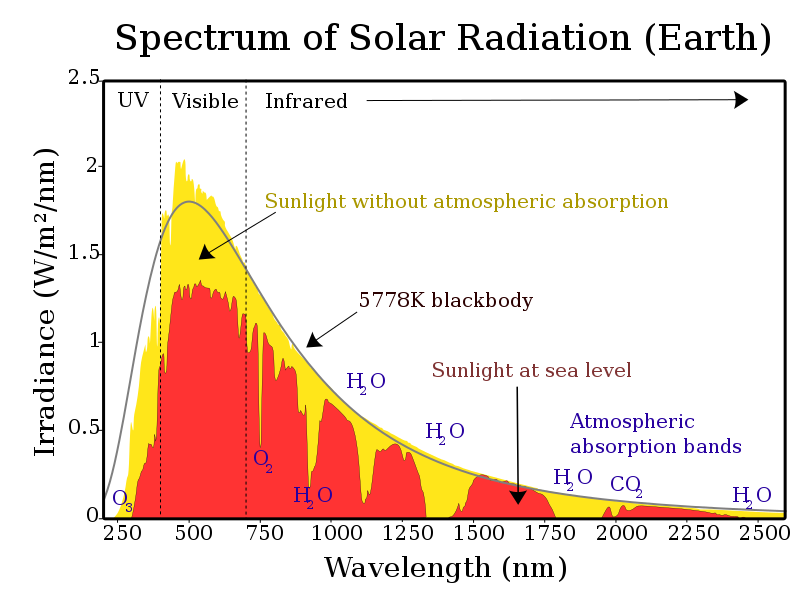
I resisted the urge on the other thread but it's mainly visible & IR radiation, not UV, that transfers most of the energy we feel as heat from the sun. UV on the other hand has a tendency to age materials (higher energy but much lower intensity). Not that it makes much difference for most people...

800px-Solar_spectrum_en.svg.png
 
Flap over the top as hierony mentioned would be a quick and cheap check to see if it helps. A massive tarp erected over the yurt to keep the direct sun from soaking the fabric? Hmm.. worth a try perhaps?

My gut tells me that you would need a kick @$$ chiller on a yurt that is sealed up (to hold in the cool) to really get the temp down during a sunny day. But that is just a guess.

My truck gets incredibly hot sitting in the sun with windows up. Air C wide open and recirc on it takes quite a bit to cool off. Same circumstance bomb down the interstate with all windows and rear window open, it cools off fast, THEN turn on AC. Just a thought. I think you'll have to do some experimenting. At least you don't have mold.
 
Lol, Bob! I guess I should have built the yurt on wheels so I could cool it off at the same time as putting the chicken to grill in my dome solar oven!
 
I've got a 12' yurt on a platform in Austin, Texas. We're about to get into 100+ degrees at 40% humidity, so cooling is paramount. My yurt is covered with recycled billboard vinyl, and currently insulated with comforters and sleeping bags I purchased at the Goodwill Outlet store for $1 each. I've purchased radiant barrier bubblewrap I intend to put between those two layers. I also have pretty thorough tree cover in every direction but straight up. I'm using a Honeywell 10,000 BTU portable AC with the water line plumbed outside. It's rated for 400 sq. ft., and I've got 113. I've got two layers of transparent shower curtain over my roof ring. One is strapped on in four corners and goes over the crown. It keeps out rain but isn't fully air or bug tight. I have another layer of the same taped to a shaped ring that goes between the crown and the roof ring, which are not attached. This forms a more airtight seal. I'm mainly working on reducing airflow out of the yurt where the roof meets that walls and around the floor. I'll be using one of those temperature-difference detection guns to look for leaks. I may look into semi-transparent radiant barrier material for a new crown cover as we get into the summer. Right now I'm able to keep it in the high 70s running the AC during the day. The high today was 87. I'm interested to see how it will go during the summer, though hopefully I'll be on the west coast for much of it.
 
I bought a can of nightshades, a tint spray that is used to darken car lenses, and I put cardboard up on all windows (they are all facing east). The tint on the dome was not enough, so I covered it with cardboard.The yurt gets some shade late afternoon, otherwise it's completely open. I have a 12k btu rated at 400 sq ft, the yurt is 300. Even with all of this, I can't hold the temp. The walls and ceiling have the radiant foil bubble wrap. I'm having the windows tinted and I'm thinking of adding another layer of bubblewrap. I'm not sure what else I can do. Anything thicker and I will have to reorder the top canvas.
 
It seems like you're trying most of the right things. Unless there is an air gap between then, adding another layer of radiant barrier bubblewrap probably won't help much. It has almost no insulating value, the only thing it really helps with is reflecting rays that penetrate the cover back out, which is vital. It also, unfortunately, keeps heat generated inside there. One thing you might consider is trying the approach of using comforters on a small portion of the roof, then using an infrared thermometer or leak detector gun to compare the temperatures of that portion and the rest. The guns can be used to pinpoint places where air is escaping.

I can totally empathize with wanting to keep the crown ring looking good. It's definitely the prettiest thing in the yurt. Right now it's a huge pain for me to ventilate because to get from sealed to open I have to wrestle my inner plug out of the way *and* go outside to fold over the roof cover. I have plans for something more like a dome with a lift, and a fan in the center, but the need to keep that area looking nice is definitely slowing me down.

Because of this, and the fact that I don't have any screened windows or doorways yet (mosquitos are murder here right now) I've been using the AC at night even though the outside temperature is very comfortable for sleeping. It feels like a betrayal of the entire idea of being more connected to nature and less wasteful of energy. I have a bug screen for the front door coming in today, and I'll be making one for the roof ring also. This should allow me to experiment with leaving the yurt open during the day to prevent heat buildup.

One that that was wasteful but felt really good was running the AC with the roof hole cracked. This felt a lot less stuffy than running the AC with a full seal.

One thing I've never understood about portable AC units. They pull air only from inside the room, but they push air back into the room *and* outside the room. Doesn't that mean that the air pressure in the room should be constantly decreasing? Either that or air is flowing in from somewhere else.

I usually try to escape to Portland, Oregon for the hottest part of the summer, so I don't know if I'll manage to get the radiant barrier installed before I leave. If I do I might do some before-and-after testing and report back.

I think, in general, that it's likely that a cooling solution that doesn't take advantage of the natural airflow out the roof ring may not work. It might be necessary to at least keep the dome cracked and run the AC at the same time. It would be very easy to compare both methods and see the result.

This couple put a fan that fits directly inside the roof ring:

Fouch-o-matic Off Grid FAQ page | Esther Emery

I'm planning on doing something similar.

Some people are having success using these with Tiny Houses:

http://energy.gov/energysaver/ductless-mini-split-air-conditioners

Another idea I like is a some kind of little tower or cover that floats a few feet above the roof ring to keep out direct sunlight, but still allows in light and airflow from the sides. One idea that Won't Go Away is mirroring the underside so that you can still see nature (and maybe yourself) through the hole.

Scott

I bought a can of nightshades, a tint spray that is used to darken car lenses, and I put cardboard up on all windows (they are all facing east). The tint on the dome was not enough, so I covered it with cardboard.The yurt gets some shade late afternoon, otherwise it's completely open. I have a 12k btu rated at 400 sq ft, the yurt is 300. Even with all of this, I can't hold the temp. The walls and ceiling have the radiant foil bubble wrap. I'm having the windows tinted and I'm thinking of adding another layer of bubblewrap. I'm not sure what else I can do. Anything thicker and I will have to reorder the top canvas.
 
Last edited:
You have several good points. One mistake I made was going off of floor square footage. I oversized it by 25%, but I didn't take into consideration that it has a high ceiling and poor insulation. I used a btu calculator that used both of those variables and it calculated 20k btu instead of 12k. I'm going to temporarily test this by adding another ac unit and if that solves it, I will purchase a mini split. We are also consider another layer of bubble wrap. Even without a space in between the layers, it will increase the R factor by 3.

It seems like you're trying most of the right things. Unless there is an air gap between then, adding another layer of radiant barrier bubblewrap probably won't help much. It has almost no insulating value, the only thing it really helps with is reflecting rays that penetrate the cover back out, which is vital. It also, unfortunately, keeps heat generated inside there. One thing you might consider is trying the approach of using comforters on a small portion of the roof, then using an infrared thermometer or leak detector gun to compare the temperatures of that portion and the rest. The guns can be used to pinpoint places where air is escaping.

I can totally empathize with wanting to keep the crown ring looking good. It's definitely the prettiest thing in the yurt. Right now it's a huge pain for me to ventilate because to get from sealed to open I have to wrestle my inner plug out of the way *and* go outside to fold over the roof cover. I have plans for something more like a dome with a lift, and a fan in the center, but the need to keep that area looking nice is definitely slowing me down.

Because of this, and the fact that I don't have any screened windows or doorways yet (mosquitos are murder here right now) I've been using the AC at night even though the outside temperature is very comfortable for sleeping. It feels like a betrayal of the entire idea of being more connected to nature and less wasteful of energy. I have a bug screen for the front door coming in today, and I'll be making one for the roof ring also. This should allow me to experiment with leaving the yurt open during the day to prevent heat buildup.

One that that was wasteful but felt really good was running the AC with the roof hole cracked. This felt a lot less stuffy than running the AC with a full seal.

One thing I've never understood about portable AC units. They pull air only from inside the room, but they push air back into the room *and* outside the room. Doesn't that mean that the air pressure in the room should be constantly decreasing? Either that or air is flowing in from somewhere else.

I usually try to escape to Portland, Oregon for the hottest part of the summer, so I don't know if I'll manage to get the radiant barrier installed before I leave. If I do I might do some before-and-after testing and report back.

I think, in general, that it's likely that a cooling solution that doesn't take advantage of the natural airflow out the roof ring may not work. It might be necessary to at least keep the dome cracked and run the AC at the same time. It would be very easy to compare both methods and see the result.

This couple put a fan that fits directly inside the roof ring:

Fouch-o-matic Off Grid FAQ page | Esther Emery

I'm planning on doing something similar.

Some people are having success using these with Tiny Houses:

Ductless Mini-Split Air Conditioners | Department of Energy

Another idea I like is a some kind of little tower or cover that floats a few feet above the roof ring to keep out direct sunlight, but still allows in light and airflow from the sides. One idea that Won't Go Away is mirroring the underside so that you can still see nature (and maybe yourself) through the hole.

Scott
 
The real solution to this problem is to erect another yurt one size bigger over the first yurt. You got your sun protection, your air flow, your insulation. Plus some yurt forum sponsor is gonna love you, big time. lol

Get a tarp over the yurt so it will not be in direct sun. How? Beats me, but if there's a will, there's a way. It will work, just as putting a hat on your head in the summer works. Think of it as an expensive hat for the brains inside the yurt. lol

I have found a tent fly always keeps the tent cooler in the summer, and warmer in the winter. Everyone heads for shade in the heat of summer.
 
Just brainstorming here. Another possibility if you are home during the day, is to simply wet down the roof. Go out every 30 minutes of so and hose it down. Just like dipping your hat in the lake while fishing, or jumping in the pool while laying out and working on that college tan. lol Nice and cool real quick. Just an idea and they are worth what you paid for them.
 
Bob, I admire your sense of humor! My thoughts are leaning towards building an arbor in the front to shade the windows, I've ordered a 24k btu mini split, and I'm going to add another layer of bubble wrap to the walls and roof. I think I would go completely mad if I had to install a yurt over a yurt!
 
A friend of mine (in a normal house with AC, but still is hot sleeping) said she bought a dog cooling pad at Bed, Bath, and Beyond for $40). Put it under her sheet and said it works great. Lol. Not really a solution for this, but perhaps for folks needing a bit more cooling - just to get to sleep until it really cools down at night. I'm going to try it. My theory is it's always cheaper, easier, and more environmentally conscientious (though perhaps viewed suspiciously in our society) to heat or cool yourself as opposed to your space. Esp if you live alone. Experimenting what works best in your situation is part of yurt life. Good luck!!
 
I got my mini split ac unit a couple of weeks ago and it's handling the Arkansas heat perfectly! I ended up purchasing a 24K BTU, which seemed overkill at first, but when I used a BTU calculator and considered poor insulation and high ceilings, this is what was recommended. I'm glad to move on to other challenges. Thanks everyone for your great input.
 
This thread is long dead, but one thing I tried last summer on the hottest days was a 52” umbrella with the handle stuck in a ten foot 3/4” PVC pipe (3 sections for easy storage). I opened the dome as wide as possible, then wedged the umbrella into the dome. At one point I taped the outside part of an indoor/outdoor thermometer on the top to monitor any heat build up. (Seemed fine). It’s not the answer to hot temperatures, but the “shade” was blissful. And a cheap, easy to set up and take down solution. My dome is 4’ wide and they measure umbrellas over the top, so I needed a 52” umbrella.

Of course, awnings (or outside covers) for doors and windows also help. Anything to keep the sun out of the yurt.
 
Last edited:
My yurt ring is 24" inside diameter. 32" OD where the rafters butt into it. My wife bought me a 'wider than normal' umbrella, and I thought it might work to cover the ring. I hung a 5 lb. weight plate from the handle. It worked but not for long. A gust caught it and yanked it part way out the hole. Fortunately it didn't break. So umbrella is no bueno around here.

I made a ring cover out of a large scrap of the 22 oz. vinyl coated tarp material I completely recovered the yurt with a couple months ago. With it centered over the hole, I tied four guy lines to the rope circling the top of the yurt wall. Works great in high wind and rain we are currently having.

Off topic. No more woodstove in the middle of my little 12'6" D. yurt. I added a second door-opposite the first door- to my lil squirt last year. Better ventilation and draft without having to roll up the bottom of the wall cover. I poured a 2x2 concrete pad in front of the second door inside the yurt, and set the woodstove on it. The pipe will run through a sheet of tin roofing I'm gonna cover the door opening with as a heat reflector. >>>>No more blasted ember holes in the cover!!! YAY!!<<<< Plus it frees up the middle of the yurt, which is really nice on this dink of a yurt.
 
Last edited:
Back
Top