Ad

Real Walls in a Pacific Yurt?

shesupsidedown

New member
I have seen a few examples in my yurt research of seemingly "real" walls in a pacific yurt.
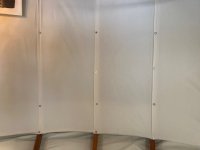
Like this: https://www.airbnb.com/rooms/900456

Any insight on how this is done? I have been toying with the idea of replacing my Pacific yurt with a Smiling Wood yurt or some other wood yurt structure, mainly because of noise, heat loss, and the lack of real walls.
If I could get walls in there I would be thrilled.

I do live in Oregon so mold might be a problem if you cove the walls?
 
If you want completely solid then companies like Smiling Wood are the way to go.

However you can also do semi solid wall interior fairly easy. From what I know the basic gist of what many folks call "solid wall" yurts. it is normal exterior with a layer of insulation and then a tongue and groove wood interior wall. It would not be too hard to buy the tongue and groove wood and install it to the interior of your yurt. And it would be cheaper than buying a whole new yurt.

The big one if you went this route is you would need to add real windows too. Pacific yurt does offer real window options that you can buy and retrofit.
 
Might I suggest you design it in a way that the walls can breath. Maybe Bob has more to add, but I was thinking a space at the bottom of the wall where air can get in, along with space at the top where it can get out. I would think this would address any condensation issues. You have to remember that the outside wall is a fabric and that when heat comes in contact with it, condensation is going to happen. It needs a place to go or mold will ensue.

Good luck!
 
If you're interested in a DIY wood yurt instead of a kit, we just self-published a book about ours. It's on Amazon under the name Marvin Denmark. We're also in Oregon!
 
We installed insulation and drywall in our Pacific yurt's walls. We used 3/8" because it bends easier. My yurt blog on my profile should have pix. Down the road I plan to replace the exterior fabric with hardy board for wildfire protection. We have had a little bit of condensation problem especially in very cold weather, but we are careful to ventilate and manage humidity so it has not caused any problems (mold, etc). In the ceiling we used R34 insulation panels and covered it up with the white yurt fabric from Pacific Yurt's insulation kit for a tidy finished look. Eventually I will replace the roof fabric with metal roofing which will include eves and ventilation like a house.
 
I love the idea of firebrand! We are in the PNW which is currently ablaze so are looking for ways to make our yurt more climate resistant.

Curious how it's going with the drywall and if you are still not having mold issues ? We really want to do this buy the potential for mold is what has stopped us. I wonder if adding narrow floor vents behind the drywall would help?

Would love an update..
 
Just wanted to update what I ended up doing:
We added regular windows retrofitted. Inside over the lattice we added rigid insulation and covered with a board that was supposed to be VOC free and was not. I reacted to it so I removed it all and covered the walls with doubled muslin fabric. I now have "walls" and the fabric was cheap, easy to hang (we made the interior look similar to a old school canvas tent with grommets and what not), and breathable. No mold issues whatsoever. That said, I love all the suggestion here!
 
I love the idea of firebrand! We are in the PNW which is currently ablaze so are looking for ways to make our yurt more climate resistant.

Curious how it's going with the drywall and if you are still not having mold issues ? We really want to do this buy the potential for mold is what has stopped us. I wonder if adding narrow floor vents behind the drywall would help?

Would love an update..


I don't think vents in the walls would be necessary. At least not in our climate where it is very windy. The wall fabric is loose enough that air moves through the walls quite well. A little too well. We went around and caulked the bottom of the drywall where it meets the floor, because it was too drafty in the winter. We also did some caulking around the windows. As I mentioned before, we have seen some spotty condensation here and there in the wall insulation, but none that has spread or moved into the drywall and our air quality seems good. Caveat: we live in a low humidity climate east of the Cascades. Make sure you have an exhaust fan for the kitchen and bathroom and/or crack the dome. We still plan to replace our wall fabric with hardy board, but have been delayed in that part of the project because of COVID prices, etc... In the mean time we have a very thorough fire break built around the yurt!
 
I am confused though....did you use fabric or drywall ? Both?

Edit...: never mind I understand now what you are saying.
 
Last edited:
I don't think vents in the walls would be necessary. At least not in our climate where it is very windy. The wall fabric is loose enough that air moves through the walls quite well. A little too well. We went around and caulked the bottom of the drywall where it meets the floor, because it was too drafty in the winter. We also did some caulking around the windows. As I mentioned before, we have seen some spotty condensation here and there in the wall insulation, but none that has spread or moved into the drywall and our air quality seems good. Caveat: we live in a low humidity climate east of the Cascades. Make sure you have an exhaust fan for the kitchen and bathroom and/or crack the dome. We still plan to replace our wall fabric with hardy board, but have been delayed in that part of the project because of COVID prices, etc... In the mean time we have a very thorough fire break built around the yurt!

I saw your pics and it looks great ! Do you have a way to check behind there easily for mold ? I would worry it's growing where I can't see. We live next to a large year round creek in a shady area of Oregon . It gets dry in summer but winters are rainy and mild..

With the fireboard...is that rain proof ? I would think the rain would mess it up. We plan to put cedar board and batten siding on. Not very fireproof though.
 
I saw your pics and it looks great ! Do you have a way to check behind there easily for mold ? I would worry it's growing where I can't see. We live next to a large year round creek in a shady area of Oregon . It gets dry in summer but winters are rainy and mild..

With the fireboard...is that rain proof ? I would think the rain would mess it up. We plan to put cedar board and batten siding on. Not very fireproof though.


We do spot inspections by unscrewing the sidewall and poking around. It IS possible that we have missed something. We always run an air purifier regardless because of the usual indoor air pollution issues in any home. So that gives us a safety factor. Is it below freezing much in your area? That's a factor for condensation. We have very cold weather every winter down into the single digits and we do get condensation running down the ceiling between the insulation and the top fabric in the morning after things thaw out.. It then runs into the walls where it seems to dry up pretty quickly because the walls are so well ventilated. Sorry I forgot to mention this before!


As for they hardy board, we will install just like on a house with a layer of plywood, then moisture barrier and then the siding and it will be water proof if we install it correctly. For the yurt's skirt, we have used galvanized metal to create a barrier to fire.
 
We added real walls and windows on our 24 foot pacific this summer. It was a bit tricky but totally doable. We first added 11/32 plywood meeting on the snow and wind load kit. Framed the windows and cut out the lattice and plywood. House wrapped the whole yurt and installed windows. We then stained 6 inch shiplap, installed it virtually and framed the windows. Contact me if you want more information or pictures.
 
Last edited:
I don't think vents in the walls would be necessary. At least not in our climate where it is very windy. The wall fabric is loose enough that air moves through the walls quite well. A little too well. We went around and caulked the bottom of the drywall where it meets the floor, because it was too drafty in the winter. We also did some caulking around the windows. As I mentioned before, we have seen some spotty condensation here and there in the wall insulation, but none that has spread or moved into the drywall and our air quality seems good. Caveat: we live in a low humidity climate east of the Cascades. Make sure you have an exhaust fan for the kitchen and bathroom and/or crack the dome. We still plan to replace our wall fabric with hardy board, but have been delayed in that part of the project because of COVID prices, etc... In the mean time we have a very thorough fire break built around the yurt!

Hi Pablo (and the entire forum), I've looked through your pics of insulated walls and sheetrock finishes in your yurt. Looks great! We've lived in a 35' Shelter Designs yurt in Upstate New York (in the Adirondacks) since July '19. Temps in the winter routinely drop into the negatives. We have three different heat sources including our primary, a good woodstove, so there's no problem keeping things warm but I've always been disappointed in two things: insulation and mold around the sill. When they built our yurt, they screwed up the fabric cut on the skirt, making it too short so the insulation doesn't come down below the finished floor height. This creates a cold area that creates mold in the winter. I am frustrated with it and would love to create walls and ceiling assemblies that meet at least the minimum code requirements for insulation. My questions to Pablo (and anyone else who has experience with insulated yurt wall and ceiling assemblies are;

1. Are you happy with the wall assembly? Does is cause any moisture buildup or is the dew point further out towards the exterior so no condensation on the interior?

2. What type of assemblies have been used successfully? I've read through posts about hardiboard but thinking something like (from outside to inside) Hardiboard + WRB + 3/8' OSB plywood + Rockwool (or sprayfoam @ 7R/inch x 5") + 3/4" T/G pine. VERY CURIOUS TO HEAR PEOPLE'S THOUGHTS ON THIS!

3. Ceiling: We have 2x12" rafters to achieve the required snow loads. Has anyone used rockwool or sprayfoam or other? It would be great to cover the ceiling with something impervious (smooth/hard) like wood or drywall; something that is able to be cleaned. Has anyone done this?

4. Roofing: I've heard of people contracting with companies that retrofit old grain silos with metal standing seam roofs. I'm contemplating this approach. If possible, the roofing company would calculate all of the angles and custom cut panels so then it's just about installation. I'm concerned that using conventional standing seam panels and cutting them to match the contours of a conical roof would result in a massive amount of waste. Has anyone successfully put a metal roof on a yurt?

Sorry for the long post. To all of you; thanks for posting and looking forward to hearing any and all comments/feedback!
 
Back
Top